Single-Tooth Implants in Cheltenham
Losing one tooth is common — through decay, a crack, a failed root canal or an accident. A single implant replaces both the visible tooth and its root, so the new tooth stands on its own without needing support from its neighbours. For many people it is the most natural-feeling way to fill a gap, whether at the front of the mouth where appearance matters most or at the back where chewing does.
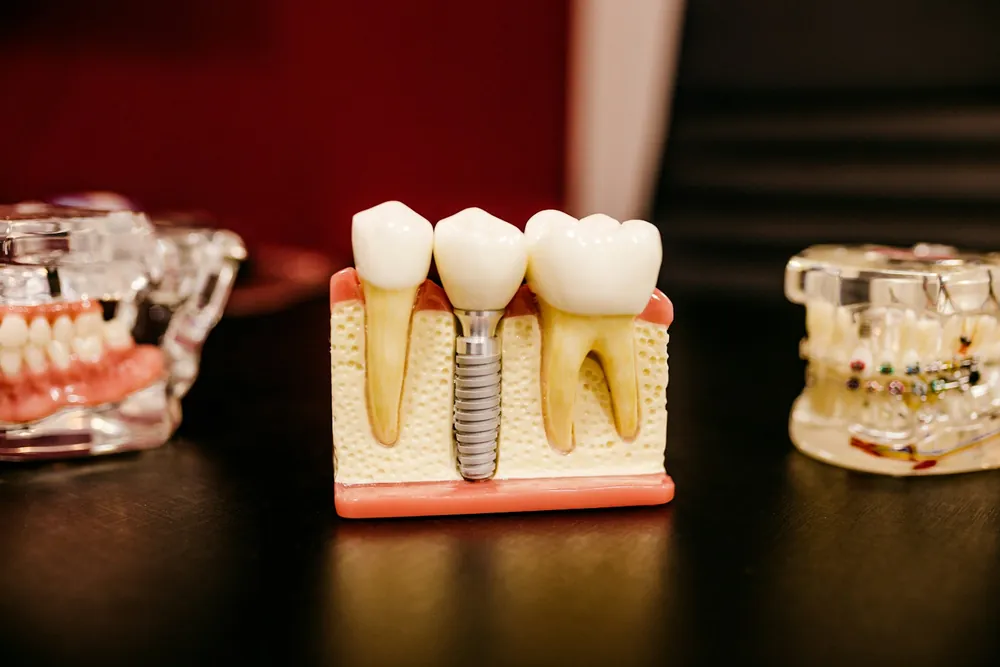
How a Single Implant Is Built
- The implant — a small titanium or zirconia post placed into the jawbone.
- The abutment — a connector that attaches to the implant and holds the crown.
- The crown — the visible tooth, made to match your other teeth in shape and shade.
Implant, Bridge or Denture?
| Single implant | Conventional bridge | Partial denture | |
|---|---|---|---|
| Neighbouring teeth | Left untouched | Usually trimmed for crowns | Clasps may rest on them |
| Feels like | A natural tooth | Fixed, solid | Removable |
| Jawbone | Helps preserve it | Bone under the gap still shrinks | Bone still shrinks |
| Treatment time | Usually 3–6 months | A few weeks | A few weeks |
| Typical cost | Highest up front | Middle | Lowest |
Am I Suitable?
Most adults in good general health can have an implant. Your dentist will look at:
- Bone — enough height and width to hold the implant, or the option of grafting;
- Gums — gum disease needs treating first, as it is a major cause of implant problems;
- Smoking — smoking raises the risk of failure, and many dentists ask patients to stop;
- Medical history — some conditions and medications, such as poorly controlled diabetes or certain bone medications, need careful assessment;
- Bite — heavy grinding can overload an implant, and a night guard may be recommended.
The Treatment Journey
Assessment
Examination, X-rays and usually a 3D scan to measure the bone and plan the implant position.
Extraction (if needed)
A failing tooth is removed. Sometimes the implant can go in the same day; often the site heals first.
Implant placement
Under local anaesthetic, with sedation available if you’re nervous. Most people return to work the next day.
Healing
Typically around three to six months while the bone bonds to the implant. A temporary tooth can fill the gap.
Final crown
The abutment and custom crown are fitted and your bite is checked.
Front Teeth: Getting the Appearance Right
Front-tooth implants are more demanding because the gum line and shade must blend with the teeth either side. Planning may include soft-tissue work or a carefully shaped temporary crown to guide the gum as it heals. Ask to see examples of the dentist’s front-tooth cases and discuss what result is realistic for your gum type.
Looking After Your Implant
Clean around it as carefully as a natural tooth — twice-daily brushing plus interdental brushes or floss — and keep up regular hygiene visits. The most common long-term problem is inflammation of the gum and bone around the implant (peri-implantitis), which is largely preventable with good cleaning and regular checks.
Typical implant prices
A single implant with crown typically costs around £2,000–£3,000 privately, with grafting extra where needed.
- Single implant with crownAbout £2,000 – £3,000
- Implant-retained denture (per arch)About £5,000 – £13,000
- All-on-4 / full-arch fixed (per arch)About £12,000 – £25,000
- Bone graft or sinus lift (if needed)About £400 – £2,500
Typical UK private price ranges gathered from published practice and industry guides in 2026. Each practice sets its own fees and confirms them after a consultation and scan. Full cost guide.
Back Teeth vs Front Teeth
A single implant at the back of the mouth is usually about strength. Molars take heavy biting forces, so the dentist will choose a wider implant where the bone allows, and a hard-wearing crown — often monolithic zirconia — that copes with grinding. In the upper jaw, the sinus sits just above the back teeth, and if bone has thinned there a sinus lift may be needed before or during placement.
At the front, the priority shifts to appearance. The gum line, the shape of the crown and the shade all need to match the neighbouring teeth closely. Front implants often involve more planning, a temporary crown to shape the gum, and sometimes a soft-tissue graft. That is one reason prices for front teeth can be slightly higher.
Looking After a Single Implant
An implant can’t decay, but the gum and bone around it can become inflamed if plaque builds up. Brush twice a day, clean between the teeth with interdental brushes or floss designed for implants, and keep up regular check-ups and hygiene visits. Your dentist will usually take an X-ray after the first year to check that bone levels are stable. If you grind your teeth, a night guard can protect the implant crown and your natural teeth.
Most practices offer a guarantee on implant treatment that depends on attending these reviews, so ask what it covers before you start.